Please bookmark this page for your future reference.
US Dollar Vs Pakistani Rupee (USD to PKR).
Compiled by Rashid Zia Cheema
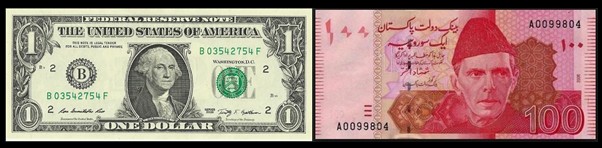
Click on the following money conversion tool to convert your US Dollars (USD) to Pakistani Rupee (PKR) and vice versa, at today’s market rate:-
US Dollar Vs Pakistani Rupee: Since the Independence in 1947, the Pakistani Rupee was linked to the Pound sterling. It was pegged to U.S. Dollar in September 1971. On January 8, 1982, it was changed to managed float regime by the government of General Zia-ul-Haq. Under this system the value of Rupee was determined on daily basis with reference to the currencies of Pakistan’s major trading partners.
After the nuclear explosion by Pakistan in 1998, a two-tier exchange rate system (official exchange rate and floating inter-bank exchange rate) was introduced, effective July 22, 1998. However, the exchange rate has been unified with effect from May 19, 2026 and a market-based floating exchange rate system has been introduced. Under this system the exchange rate is determined by the demand and supply positions in the foreign exchange market. Now, Pakistan is maintaining floating rate, wherein each bank quotes its own exchange rates.
US Dollar Vs Pakistani Rupee Exchange Rate since 1947
| Year | Pak Rupees | Year | Pak Rupees | Year | Pak Rupees | |
| 1947 | N.A. | 1972 | 8.6814 | 1997 | 41.1115 | |
| 1948 | 3.3085 | 1973 | 9.9942 | 1998 | 45.0467 | |
| 1949 | 3.3085 | 1974 | 9.9000 | 1999 | 49.5007 | |
| 1950 | 3.3085 | 1975 | 9.9000 | 2000 | 53.6482 | |
| 1951 | 3.3085 | 1976 | 9.9000 | 2001 | 61.9272 | |
| 1952 | 3.3085 | 1977 | 9.9000 | 2002 | 59.7238 | |
| 1953 | 3.3085 | 1978 | 9.9000 | 2003 | 57.7520 | |
| 1954 | 3.3085 | 1979 | 9.9000 | 2004 | 58.2579 | |
| 1955 | 3.9141 | 1980 | 9.9000 | 2005 | 59.5145 | |
| 1956 | 4.7619 | 1981 | 9.9000 | 2006 | 60.2713 | |
| 1957 | 4.7619 | 1982 | 11.8475 | 2007 | 60.7385 | |
| 1958 | 4.7619 | 1983 | 13.1170 | 2008 | 70.4080 | |
| 1959 | 4.7619 | 1984 | 14.0463 | 2009 | 81.7129 | |
| 1960 | 4.7619 | 1985 | 15.9284 | 2010 | 85.1938 | |
| 1961 | 4.7619 | 1986 | 16.6475 | 2011 | 86.3434 | |
| 1962 | 4.7619 | 1987 | 17.3988 | 2012 | 93.3952 | |
| 1963 | 4.7619 | 1988 | 18.0033 | 2013 | 101.6290 | |
| 1964 | 4.7619 | 1989 | 20.5415 | 2014 | 101.1001 | |
| 1965 | 4.7619 | 1990 | 21.7074 | 2015 | 102.7693 | |
| 1966 | 4.7619 | 1991 | 23.8008 | 2016 | 104.7691 | |
| 1967 | 4.7619 | 1992 | 25.0828 | 2017 | 105.4552 | |
| 1968 | 4.7619 | 1993 | 28.1072 | 2018 | 121.8241 | |
| 1969 | 4.7619 | 1994 | 30.5666 | 2019 | ||
| 1970 | 4.7619 | 1995 | 31.6427 | |||
| 1971 | 4.7619 | 1996 | 36.0787 |
Source:
Pacific Exchange Rate Service (page 3/3)
Where can I find dollar vs PKR exchange rates over the years since 1947?
US Dollar Vs Pakistani Rupee: Gazette of Pakistan showing Exchange Rates on 13th October 1950
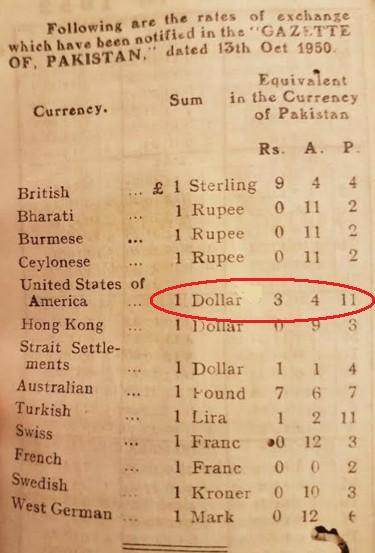
Readers of this website are also requested to share copies of Gazette of Pakistan pertaining to different years showing Exchange Rates of US Dollar Vs Pakistani Rupee.
Related Posts:
Convert Table United States Dollar to Pakistani Rupee
United States Dollar (Wikipedia)
Pakistani Rupee (Wikipedia)
Pakistani & International Stock Markets & Indices
Rare Newspapers & Magazines Headlines about Pakistan
Editor’s Note:
If you have liked this post (US Dollar Vs Pakistani Rupee), please feel it free to share it on Facebook, Twitter or any other social media.
You may also write a brief comment in the Comment Box titled “Leave a Reply here”.
 Large Visitor Globe
A painstakingly authored article covering all the relevant areas. Very informative.
It is not important how much your currency is worth against any foreign currency but what is more important is how much does a nation produces, the world’s average per capita GDP is US$ 15,400 versus Pakistan’s US$ 1,450. The exchange rate mechanism is too complicate to understand for 99.99 people in any nation, so instead of looking at the exchange rate, it is better to contribute maximum work to the nation. Japan’s currency fluctuates from 60 Yen to a dollar to 130 Yen to a dollar, so when Japan’s currency trades at 130 Yen to a dollar, the Japanese doesn’t become a poor or a third world country. Pakistan’s potential is to have a GDP of $1.50 trillion per annum, the sooner we achieve, the better for us.
To me, the only measure of a country’s economic progress and nation’s prosperity is her economic output, its production capacity first and second what value added goods it produces. This world is a big bazaar, every person/country must be an active and effective buyer and seller, with competitive buying and selling capacity, only then you are recognized and are wanted in this society.
Pakistani taraqi karnay ki bajaye ….. aapas mein lar kar dusroun ko keh rahay hain kay hum per hasso…..
Humain apnay mulk kay future ka sochna chahiye. Sub mill kar kaam karain tou bhala ho sakta hai humaray PAKISTAN ka……
When politicians will bring all money out of Pak to buy properties in Dubai and London .it’s natural it will happen .
1947-2000 tou 8 se 53 pa gya uska bad 2000-2017 tak seda 104 pagal to ni hu gae harami
Brother 1947-2000 tak dollar 660% barha tha. And 2017-2000 mein 200% barha hai. But still humari economy grow honay k bajaye weak ho rhi hai
It’s a nice Post. Great information for whole nation.
Thanks for the information, dear admin!
It’s bad to hear this but cool to get $$. 🙂
Very sad. It’s only because of our politicians.
Well said!
Great piece of information.
Rashid Cheema, you are a guru. God Bless you.
Oops! the numbers after 2010 are not correct. The value listed for 2013 is the current value of dollar-rupee exchange.
Can the editor, please, fix the error. Thank you Colonel.
Corrected.
Thank you for the nice work. It is quite understandable for any political-economist who had been keeping track of historical developments in the world market. We see a stable price, up till 1971, with a two to three percent inflation both in the domestic and international prices. The world currencies were pegged to the U.S. dollar under the Bretton Woods arrangements and the U.S. dollar in turn with the gold, (popularly known as gold standards). The prices remained stable right up to 1971 when the dollar was de-linked with gold standards by President Nixon. The action was primarily taken to control the growing inflation/unemployment/salary hikes. This created a domino effect in the world currency markets. The 1973 depreciation can be attributed to oil crisis in the aftermath of Yom Kippur War. The prices of oil jumped from $ 5 per barrel to $ 25 per barrel creating a havoc in the world market.
Enter the Afghan War, our mard-e-momin, influx of petro-dollars both under the table for war support, and the foreign exchange earned by our hard-working Dubai-based emerging middle class, the dollar-rupee dance touched the bottom in one decade. What happened after that is just history. Our informal sector swallowed pushing the established accounting norms to the brink. Islam as a surkhi-powder (make-up on the face) and undercurrents were/are telling a very different tale: drugs, kalashnikov, scramble for residential plots, money laundering, and a shift of our financial capital from Karachi to Dubai. There is too much to say but I better stop. It will do no good to me or to the country but will give me more heart-burns.
Hi Maqsood, great work!!!
Every word you said is based on facts of course…the crucial facts, however, it does good to certain extent, even if its just catharsis!
Great work by your economic desk although it’s depressing to see how our rupee has devalued over the years.
Qaiser Khalil,
Yes, it is depressing to see this devaluation, not just in our currency but unfortunately, in everything.